Free SIP Calculator Nepal
SIP · Lumpsum · Step-Up SIP — Illustrative projections for financial planning
💡 Illustration only. Select an assumed return using the scheme’s official reports; actual mutual fund returns vary and are not guaranteed.
| Period | Invested (रू) | Returns (रू) | Total Value (रू) | Gain % |
|---|---|---|---|---|
| Calculating… | ||||
SIP Calculator is a free online tool designed to help every Nepali investor guide them with an easy calculator to calculate their returns based on their investment value and planning. By using this SIP Calculator Nepal, you can easily use all features online to calculate your plan before investing in any mutual fund schemes offered by Issue Manager.
A Systematic Investment Plan (SIP) is a method of investing a fixed amount at regular intervals in an eligible mutual fund scheme. SIP is not a separate type of mutual fund; it is an investment arrangement commonly offered with open-ended schemes. Before starting, investors should read the scheme documents, understand the applicable fees and risks, and verify registration and payment instructions with the official fund manager.
Complete Guide to SIP Investing in Nepal before using the SIP Calculator
Suppose you are an investor and want to calculate the returns as of. Now, if you’re planning to start investing in a mutual fund through SIP, then this calculator will be the best online tool for you. With this free calculator, you can easily calculate the returns with different methods, such as expected rate of return, monthly investment amount, and desired tenure (no. of years), as per your requirement.
What Is SIP (Systematic Investment Plan)?
SIP (Systematic Investment Plan) is a preset habit of investing a fixed amount of money regularly (monthly, quarterly, semi-annually, or annually) in mutual funds. In practice, it’s the process of buying the specific units of mutual funds (schemes) from an issue manager like Nabil Investment for NI31 & Nabil Flexi Cap, or Laxmi Capital for Subha Laxmi Kosh, with your monthly contribution.
In simple terms, although you invest Rs 1000 monthly, for example, in NI31 by Nabil Investment, you pay Rs 1000 to Nabil Investment every month for your NI31 Scheme. After paying Rs 1000 to them, you are done on your end, and many of us think I invested Rs 1000 for this month too.
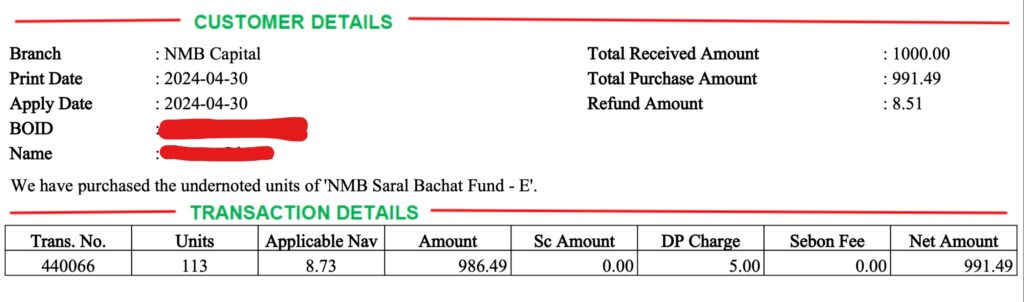
But the real practice of mutual funds is not directly investing the rupees (money). Still, a mutual fund is a capital market, so based on the current market value of that mutual fund (may be Rs 11.0 per Unit called NAV in investment terms), in that case, the issue manager separates or purchases the x units up to your monthly investment of Rs 1000, which is around 90 Units only. So, here you need the SIP Calculator that I made free for you all.
When you contribute to an open-ended mutual fund through SIP, your contribution is used to purchase units at the applicable NAV according to the scheme’s terms. Fees, taxes and other deductions may vary by scheme and transaction, so check the official offer document or current fee schedule instead of assuming that a fixed DP charge applies to every instalment. The examples below show how units appeared in sample transaction records.

SIP Vs One-time (Lumpsum) – Which is Best for SIP Calculator?
So, now you are clear about SIP Investment. Now let’s talk about the two methods used in investing: SIP vs. lump sum. The choice between a Systematic Investment Plan and a lump-sum investment depends entirely on your cash flow and current cash holdings. Also, depends largely on the market volatility you can stomach.
SIP vs Lumpsum — Quick Comparison
Hope you got it! So which one should you choose?
Go with SIP if:
- You want investment discipline: If you want to set investment discipline, you can go with SIPs, as they make a habit of regular savings or investments.
- You have a regular lump sum: If you are a salaried person or have regular income from any source, then it’s the best investment habit ever for you.
- You are building a corpus: If you plan to achieve long-term goals with minimal regular income, then it’s for you.
- You don’t have a larger investment amount: A lump-sum investment may grow more when money is invested earlier and the market performs positively, but it can also experience larger short-term losses. The appropriate approach depends on available funds, investment period and risk tolerance.
Go with a lump sum if:
- You have a windfall: If you receive a good amount from your investment, business, or maybe from closing or a festive bonus, then it will be the best Investment opportunity.
- You have a large investment amount. If you already have a good portion of the amount to invest, go with a lumpsum investment, as it compounds faster each year.
Why SIP Works Well for Nepali Salaried Investors
A SIP can help salaried, freelance and other regular-income investors contribute consistently over time. Contribution amounts and minimums vary by scheme, contribution frequency and payment channel. Choose an amount you can maintain and confirm the current minimum through the fund manager’s official website before registering.
Regular SIP contributions may be aligned with a monthly, quarterly or other permitted payment schedule, depending on the scheme’s rules. Whether a distribution is paid in cash, reinvested as additional units or reflected in the scheme’s NAV depends on the particular scheme and investment option. Do not assume that every dividend is automatically reinvested; confirm the applicable policy in the official scheme documents.
Open-ended mutual fund schemes in Nepal are managed by SEBON-regulated fund managers, but regulation does not remove investment risk. Depending on the scheme, investors may face market, liquidity, credit, interest-rate, operational and regulatory risks. Returns are not guaranteed. Review the scheme documents and latest official reports before investing, and read our Financial Disclaimer.
How SIP Works in Nepal (Step by Step): Requirements for SIP Registration Process
SIP registration requirements and payment options vary between fund managers and schemes. Always check the latest instructions on the selected fund manager’s official website before submitting personal information or making a payment.
Check the BOID/DEMAT Requirement: Many open-ended mutual fund registration portals request a valid 16-digit BOID. Use the exact account details maintained by your Depository Participant and preserve any leading zeros.
Check Whether MeroShare or CRN Is Required: MeroShare and a CRN/C-ASBA registration may be required for certain investment or payment processes, but they are not universal requirements for every SIP registration channel. Follow the official checklist provided by the selected fund manager.SBA, the Bank will register it for you and link it to your DEMAT Account.
Review Available Schemes: Review the open-ended mutual fund schemes currently offered by SEBON-regulated fund managers. Compare each scheme’s investment objective, asset allocation, risk level, fees and official reports. Do not select a scheme solely because of its bank name, a recent dividend or past performance.er.
Register SIP with Fund Manager: After choosing the SIP Plan/Scheme, visit the Issue Manager SIP Registration page and create a user there, then fill out all the details with your investment requirements. If you want SIP at NIBL Sahabhagia Fund, visit the NIMB Ace Capital SIP Registration Page.
Start Investing: After setting all SIP Plan details, start paying your Monthly SIP using available Payment Methods in checkout. That’s all.
You can click/tap here to learn how to open a SIP Account and here to learn how to pay SIP online easily.
How to use SIP Calculator: Steps for Calculation
So, let’s get into the practical steps to calculate the SIP using our SIP Calculator. Here I have shared the actual steps based on the SIP Calculator on this site.
Step 1: Ensure the Function/tab is set to SIP. By default, it’s chosen as SIP. If not, tap SIP.

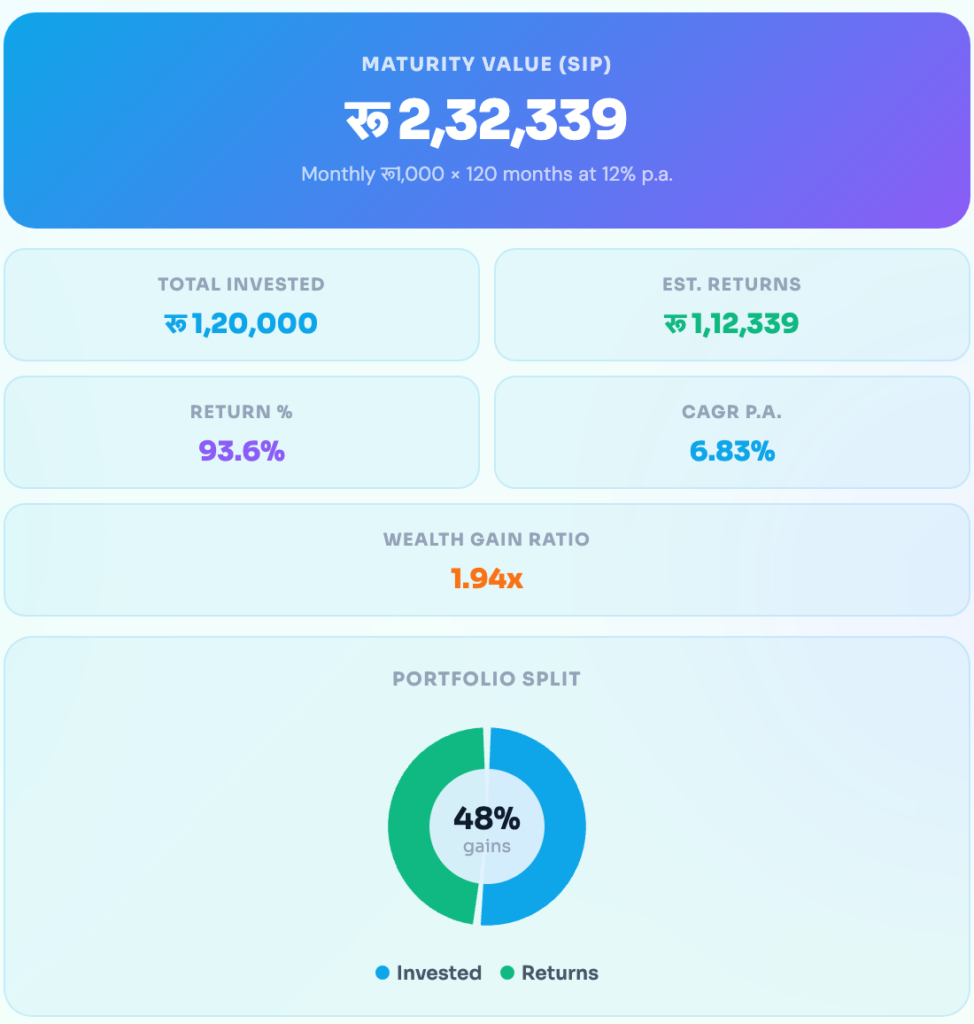
Step 2: Now enter your monthly investment amount. As per your requirement, you can select a scale or enter manually. Here I am selecting Rs 1000.

Step 3: Set the investment Period. Here, for example, I am setting 10 Years. But as per your requirement, you can set any duration.

Step 4: Enter an assumed annual rate of return for the projection. This rate is used only to illustrate a hypothetical scenario; it is not the scheme’s declared dividend or a guaranteed future return. Consider testing several assumptions to understand how different rates affect the result.

Step 5: That’s all. Happy Investing! Here you will see the complete details view, with yearly and monthly breakdowns.

Frequently Asked Questions
SIP is a simple investment plan in an open-ended mutual fund with a long-term goal. SIPs work like mutual funds, compounding your investment.
The minimum SIP contribution is determined by each mutual fund scheme and may vary according to the fund manager, contribution frequency and payment channel. Check the scheme’s current offer document or official registration portal for the latest minimum amount before registering.
The calculator applies a mathematical projection formula to the amount, period and assumed return entered by the user. It can calculate that hypothetical scenario consistently, but it cannot predict actual mutual fund performance or future NAV changes. Unless specifically stated, the result may not include taxes, fund-management expenses, transaction charges or other deductions. Treat every result as an illustration and verify actual figures with the fund manager.
Yes, most Issue Managers allow investors to customize their existing SIP Plan on their websites easily. So, the investors can do it easily from the user dashboard.
There is no single return rate that applies to every mutual fund in Nepal. Use the calculator to test multiple assumed rates rather than relying on a fixed industry average. Review the specific scheme’s official reports, NAV history, fees and risk disclosures before selecting an assumption. Past performance does not guarantee future returns.
Yes, this SIP Calculator NP is completely free to use for everyone. So, start calculating and start investing.
NAV is the Net Asset Value of that Mutual Fund. Based on NAV, your Issue Manager will purchase mutual fund units on your behalf.
Some issue managers, like Nabil Investment Banking, allow you to redeem the SIP easily from their dashboard. For other users, they must fill out the form and send it to the concerned department of the Issue Manager via mail, or they can also visit their parent company (Bank) to submit the redemption or cancellation form.
Conclusion
SIP investing in Nepal is not about timing the market — it is about staying consistent with your preset investment plan. Use the SIP calculator NP above to plan your SIP for the future goal, read our guides to understand the process, and start with an amount you can sustain every month. That’s all for the SIP Calculator. Thank you!
Mutual fund investments are subject to market risk; treat every projection as an estimate, not a promise.