
About Us: Namaste! My name is Basanta Limbu, and I am the person behind SIP Calculator NP — every calculator, every line of code, every blog post, every late-night debugging session. This is a one-person project, and I want to tell you honestly why I built it and what drives me to keep improving it.
A Little About Us (About Me)
I am Basanta Limbu, a banker currently working at ‘A’ Class Commercial Bank. I am the person behind SIP Calculator NP. I built this free SIP Calculator tool to help Nepali people easily understand SIPs, Mutual Funds, savings, and daily money management decisions.
Although I am not a licensed investment advisor. I work in Nepal’s banking and financing system daily and turn that learning and experience into tools that make it easy for every investor and anyone who aims to save or invest for the future.
I am deeply invested in Nepal’s capital markets. Although I am not a heavy investors but i still contribute a minor portion of my salary income to different financial growing tools and platforms. So, I follow NEPSE movements, track NRB’s monetary policy circulars, read SEBON compliance updates, study mutual fund NAV reports, and keep a close eye on how commercial banks, development banks, and finance companies adjust their deposit and lending rates each quarter.
This is not just professional interest for me — it is personal. I invest my own money in Nepal’s mutual funds and different SIPS Schemes. I hold recurring deposits. I plan my own retirement using the same tools I have built on this website. When I say these calculators are built for Nepali investors, I mean they are built for people like me first.
Why I Built SIP Calculator NP
The idea behind the starting of this minor web blog is the emerge of frustration that I experience in finding the best tool for SIP. When I first started investing in mutual funds through the Nepali capital market, I wanted a simple tool to project how my SIP contributions would grow over 10 or 15 years.
Then, I started searching online and found dozens of SIP calculators — but every single one was built for the Indian market, and also detail breakdown are not so clear and easy to understand. The compounding formulas followed SEBI norms, not SEBON norms (not all websites). The currency was Indian Rupees, not Nepali Rupees. The tax assumptions, the fund house references, the expected return benchmarks — none of it applied to my reality as a Nepali investor.
I tried adjusting those Indian calculators by plugging in my own numbers, but the results never quite matched what my fund manager’s statements showed. The underlying math was different. The way NabilInvest calculates SIP returns, for example, is not identical to how an Indian AMC does it. The way Nepali banks compound interest on recurring deposits follows NRB’s quarterly compounding standard — not the monthly compounding that most international calculator websites assume.
These are not minor differences. If you are a salaried employee in Nepal putting NPR 5,000 per month into a mutual fund SIP, even a small formula mismatch can show you a projected maturity value that is lakhs of rupees off from what you will actually receive. That is not helpful — it is misleading. And I did not want to keep relying on tools that were misleading me about my own money.
So I decided to build my own. I opened my code editor, pulled out the actual formulas from Nepali fund house documentation, cross-verified the math against published NAV growth data, and built a SIP calculator that gives results consistent with how Nepal’s asset management companies actually calculate returns. That first calculator became the seed of what is now SIP Calculator NP.
What I Have Built So Far
At first, my aim was just to build a SIP Calculator, but later inside it I aimed to grow more financial tools that are interrelate to it. So, I designed other financial tools like FD Calculator, RD Calculator and other which are complementary to SIP and its compounding by following the Nepal-specific financial logic. Some major assets I would like to share with you are:
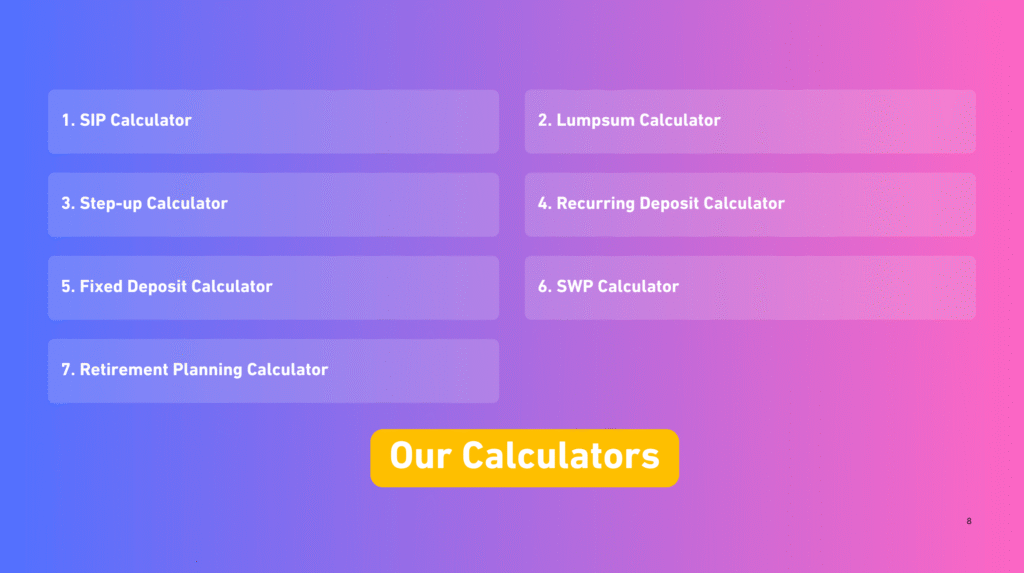
SIP Calculator — This is my flagship tool and the reason this website exists. It lets you project the future value of systematic investment plan contributions into Nepal-based mutual funds. I built the underlying formula to match how fund managers like NabilInvest, Siddhartha Capital, Laxmi Capital, Global IME Capital, NMB Capital, and NIBL Capital actually calculate periodic investment growth. You can model weekly, monthly, or quarterly contributions and see projected growth over 5, 10, 15, or even 25 years. I have personally cross-checked this calculator’s output against my own mutual fund statements to make sure the numbers align.
Lumpsum Calculator — For those times when you have a one-time amount to invest — maybe you received a bonus, sold property, or have savings sitting in your bank at a lower interest rate — this calculator helps you see how a one-time mutual fund investment could grow over time. The compounding logic follows the methodology used by Nepali asset management companies like Nicasia Capital for lump-sum investment projections.
SWP Calculator (Systematic Withdrawal Plan) — This one is close to my heart because I think about financial independence a lot. If you have already built a corpus through years of SIP investing and now want to withdraw a fixed amount each month while keeping the remaining investment growing, this calculator shows you how long your money will last and what your remaining balance will look like over time. It is an essential tool for anyone approaching retirement or planning to supplement their income from investments.
RD Calculator (Recurring Deposit) — Recurring deposits are one of the most common savings instruments in Nepal. Almost every salaried person I have met in my banking career has had an RD at some point. But here is the thing most people do not realize: Nepali banks and BFIs compound RD interest quarterly, as per NRB norms. Most international RD calculators use monthly compounding, which gives you a different — and incorrect — maturity figure for Nepal. My RD calculator uses quarterly compounding because that is what your bank actually does with your money. The difference matters, especially on larger deposits or longer tenures.
FD Calculator (Fixed Deposit) — Whether you are parking funds with Nabil Bank, NIC Asia, Global IME, Himalayan Bank, Machhapuchhre Bank, or a local development bank or finance company, my FD calculator projects your maturity value using NRB-standard quarterly compounding. You enter your principal, the annual interest rate your bank is offering and the tenure, and you see exactly what you will get at maturity. No guesswork, no foreign compounding methods, just the math your bank uses.
Retirement Planning Calculator — This is probably the most important calculator on the site, and honestly, the one I wish more Nepali people would use. Retirement planning is something most of us in Nepal do not think about until it is too late. I built this tool to give you a realistic projection of how much you need to save each month to maintain your lifestyle after you stop working. It uses a 7% average inflation rate based on Nepal Rastra Bank’s published CPI data — not some global average that has nothing to do with the price of rice, rent, and school fees in Kathmandu, Pokhara, or Butwal. It also factors in EPF (Employees’ Provident Fund), CIT (Citizen Investment Trust), and SSF (Social Security Fund) contributions so that you can see the complete picture.
What Makes This Different From Other Calculator Websites
I designed these calculators to provide a clear and accessible planning experience. Each tool applies a stated mathematical formula to the information entered by the user. However, the results are estimates and may differ from actual bank or fund figures because of fees, taxes, transaction timing, scheme rules and market movements.
Nepal-focused assumptions: Where applicable, the calculators use Nepali currency, locally relevant contribution frequencies and assumptions designed for common financial products available in Nepal. Regulations, tax treatment, bank calculation methods and mutual fund rules can change. Users should therefore verify results against current official documents and their actual bank or fund statements. If you notice a discrepancy, please contact me so I can investigate it.

The context is Nepali. When I write about mutual funds, I am writing about SEBON-regulated open-ended and closed-ended schemes traded on NEPSE. When I mention banks, I am talking about NRB Class A, B, and C institutions that you can actually walk into in Butwal, Kathmandu, or Biratnagar. When I discuss retirement, I am factoring in the real cost of living in Nepal — not New York or Mumbai. Everything on this website is grounded in the financial reality you and I actually live in.
I use these tools myself. This is not an abstract project for me. I run my own SIP projections through this calculator before adjusting my monthly contributions. I check my FD maturity estimates here before deciding on a tenure at my bank. I use the retirement planner to track whether I am on pace for my own financial goals. When I find a bug or an inaccuracy, it bothers me personally — because it means my own planning was off, too.
My Other Work
SIP Calculator is one of my valueable product where I aimed to make every financial investor who are enthusiate in investing or start journey in SIP Investment. Besides this i also run CalculatorNP.com, a broader financial calculator platform for Nepal that includes tools like an EMI Calculator for home and vehicle loans, a Salary Tax Calculator built around Nepal’s latest FY income tax slabs and Social Security Tax structure, and additional financial planning tools tailored to Nepal’s regulatory environment.
Both websites share the same purpose: to provide free educational tools that help users explore financial scenarios. I maintain the calculators and revise their assumptions when official rules, tax provisions or product terms change. The results remain estimates and should not be used as the sole basis for a financial decision.
My Commitment to Accuracy and Transparency
Financial content requires particular care because visitors may use it as part of their planning. My goal is to explain every important assumption, avoid inflated expectations and correct identified errors promptly. These calculators are educational tools and do not replace official bank statements, fund reports or advice from a qualified professional.
This website is maintained by one person. I test the formulas and review relevant sources, but mistakes or outdated information may still occur. If a result differs from an official bank or fund statement, please contact me with the inputs and source used so I can investigate the discrepancy and update the tool when necessary.
I should also be clear about what this website is not: it is not a financial advisory service. I do not manage money, recommend specific funds, or tell you where to invest. I build tools and write educational content. Your financial decisions should always be made in consultation with a qualified financial adviser who understands your personal situation — not based solely on a calculator output, no matter how accurate that calculator is.
Why I Keep Doing This
Nepal’s mutual fund industry is still young. SIP investing is still a relatively new concept for most Nepali households. A lot of people I talk to — friends, family, colleagues at the bank — are curious about investing but feel intimidated because they do not understand how the numbers work. They hear terms like “compounding,” “NAV,” “SIP returns,” and “inflation-adjusted corpus,” and their eyes glaze over.
I built SIP Calculator NP because I believe a good calculator can do what a hundred blog posts cannot — it can show someone, in concrete numbers and clear charts, exactly how their small monthly contribution today can grow into something meaningful over 15 or 20 years. When a young person in Butwal or Birgunj enters NPR 2,000 per month into my SIP calculator and sees the projected value after 20 years, that moment of realization — “wait, I can actually build wealth on my salary?” — is why I keep working on this.
Financial literacy should not be previlage to higher earning ones; it should be excel to everyone to be financially strong. Every working Nepali deserves access to tools that help them understand their money. That is what SIP Calculator NP is here for, and as long as people find it useful, I will keep building, improving, and maintaining it.
That’s all about us. I express my thank your for visiting and thank you for trusting this platform that you are using for your financial planning. If you have questions, feedback, or suggestions, I am always just an email away.
— Basanta
Creator, SIP Calculator NP
Belbari, Nepal