
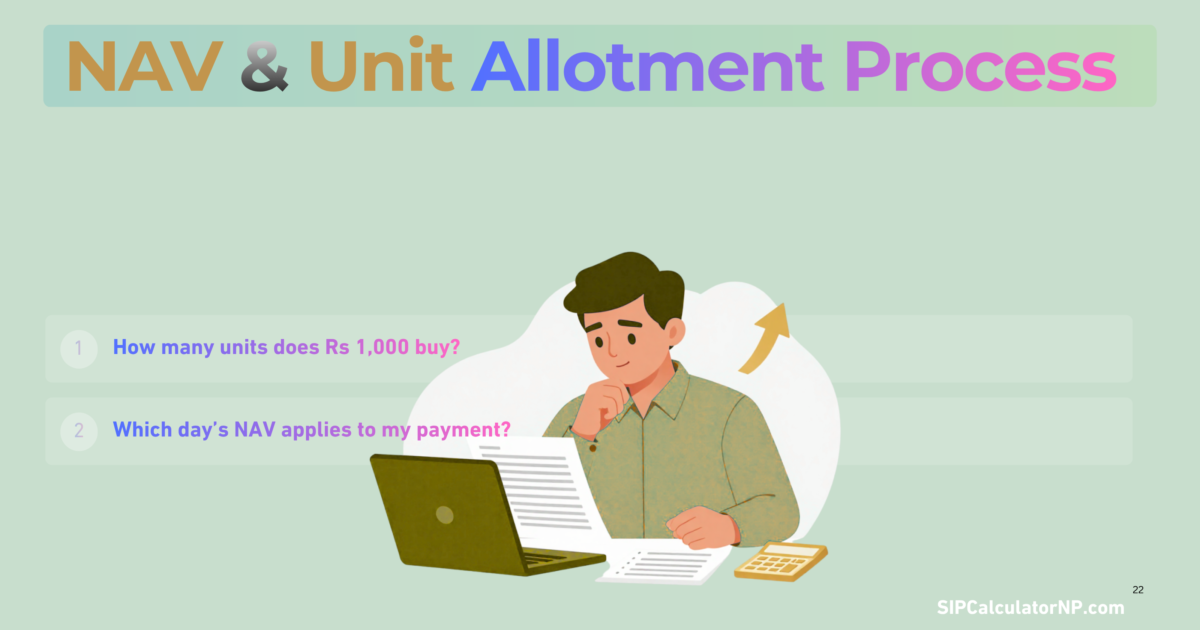
SIP units are calculated using the amount available for investment and the scheme’s applicable Net Asset Value, or NAV, per unit. When charges are deducted from your payment, a useful formula is: units = (payment − applicable deducted charges) ÷ applicable NAV. If charges are paid separately, use the full amount invested in the numerator.
NIMB Ace Capital publishes a net-payment-over-NAV calculation for its SIP. That supports the method, but does not establish an identical charge or processing rule for every fund. Source: NIMB Ace Capital FAQs.
What does NAV mean?
NAV per unit = (value of the fund’s assets − its liabilities) ÷ units outstanding. If a hypothetical fund has Rs 120 million in assets, Rs 2 million in liabilities and 10 million units, NAV is Rs 11.80 per unit.
The portfolio’s value, income, expenses and distributions can affect NAV. Your unit count does not increase merely because NAV rises. Instead, the units you already hold become worth more at that valuation.
A lower NAV does not automatically make one fund cheaper or better than another. Compare mandate, portfolio, costs and total-return history. NAV levels alone are not a ranking system.
Example: how many units does Rs 1,000 buy?
The following figures are invented to explain the calculation. Rs 10 is an illustrative charge, not a published tariff.
Where a calculation produces fractions, use the scheme’s permitted precision and rounding method. Do not round each intermediate step differently from the statement and then assume the final difference is an error.
Three purchases: calculate average unit cost
Assume three Rs 1,000 payments, each with the same hypothetical Rs 10 deduction.
Rs 990
Rs 11
90
Rs 990
Rs 9
110
Rs 990
Rs 12
82.5
Rs 2,970
—
282.5
The net investment per unit is Rs 2,970 ÷ 282.5 = approximately Rs 10.51. Your total cash paid per unit, including those charges, is Rs 3,000 ÷ 282.5 = approximately Rs 10.62. These are explanatory cost measures, not instructions for a tax or WACC filing.
If NAV is now Rs 10, the holding is worth Rs 2,825 before sale deductions. Compared with Rs 3,000 paid, that is Rs 175 less. Buying more units during the lower-NAV month helped average the purchase price, but did not prevent a loss.
Which day’s NAV applies to my payment?
Use the fund’s transaction rule, not the NAV you happened to see when opening the payment app. For example, Nabil’s individual SIP form ties execution to receipt of funds in the designated account and the applicable NAV for the received date. Source: Nabil SIP application form. Confirm the current form and operational cut-off before relying on that wording.
Record four items separately: the scheduled instalment date, payment time, the fund’s receipt or processing date, and the allotment NAV date. Ask how holidays, late receipts and incomplete applications are handled. There is no single cut-off time asserted here for all Nepali schemes. NIMB Ace Capital’s published SIP terms, for example, tie purchase to receipt of funds in the manager’s account at the applicable NAV.
My observed allotment timing — Basanta Limbu: I have invested through more than ten Nepali SIP schemes. My first SIP was NIBL Sahabhagita Fund, followed by NMB Saral Bachat Fund–E. In my own NIBL and NMB payments, the units typically appeared about three to four business days after payment; with Nabil Investment, I observed allotment within about two business days. These are my experiences, not a promised service standard. Timing can vary with the manager, payment receipt, holidays, KYC status and the applicable scheme process. If units are missing, compare your payment reference with the manager’s statement and ask the manager for the transaction’s NAV and allotment status.
How to reconcile an allotment statement
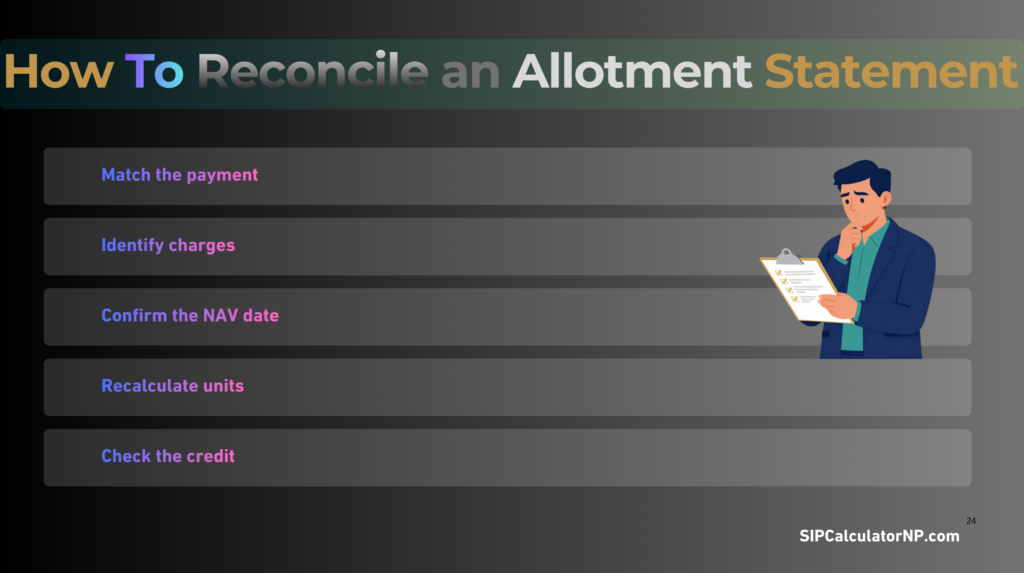
1. Match the payment. Compare the transaction reference, amount and scheme.
2. Identify charges. Check each deduction against the published schedule or obtain a written breakdown.
3. Confirm the NAV date. Use the date stated for that transaction and the scheme’s official NAV record.
4. Recalculate units. Divide the investment amount by the applicable NAV and account for the scheme’s rounding.
5. Check the credit. Match the allotted quantity and BOID with your holding records after the stated processing period.
A shortfall is not automatically a valid fee. If Rs 2,000 was paid but only Rs 1,950 is shown as invested, ask the manager to explain the Rs 50 difference. Possible causes must be established from records, not guessed.
Do dividends add to NAV returns?
When a fund pays a cash distribution, assets leave the fund. All else equal, NAV falls by the distribution per unit. For example, 100 units at Rs 12 represent Rs 1,200. After a hypothetical Rs 1-per-unit cash distribution, Rs 1,100 in units at Rs 11 plus Rs 100 cash still totals Rs 1,200 before tax and other changes.
Reinvesting a distribution may buy additional units according to the scheme’s rules. Avoid adding a dividend yield to a return measure that already includes reinvested distributions; that would double-count it.
Why does my calculator projection differ from the statement?
A projection assumes a return pattern and contribution schedule. A statement records actual purchases, NAVs, charges and distributions. Missed payments, withdrawals, different timing and reinvestment choices can all create differences. For repeated contributions, a cash-flow-aware return measure such as XIRR is more appropriate than treating the entire contribution total as money invested on day one.
Frequently asked questions
No. NAV measures net assets per unit. A listed fund’s exchange price is determined through trading and may differ from NAV. Follow the pricing mechanism of your particular scheme.
No. A price change affects value. A changed quantity needs a separate explanation, such as a purchase, redemption, reinvestment or adjustment.
Start with the fund manager for allotment and the DP for Demat records. Include your transaction reference and dates through secure channels. See the complaint preparation guide if the issue remains unresolved.
New to the terminology? Start with SIP full form and meaning.
Research checked: 27 September 2026. This article is general education, not a personal investment recommendation. Scheme terms can change; confirm current requirements with the provider.




💬 4 Comments