
The most costly SIP mistakes often start before the first payment: choosing an unaffordable amount, misunderstanding risk or buying a fund without reading its terms. A Systematic Investment Plan makes investing regular. It does not make the investment risk-free.
Use the following checks to assess your plan. They are especially useful when a rising market makes investing look easy or a falling market makes every decision feel urgent.
1. Treating a calculator’s return as a promised interest rate
A calculator needs an assumed return to produce a projection. Entering 10% does not mean a Nepali fund has agreed to pay 10% a year. The actual result depends on investment performance, costs and the timing of your contributions and withdrawals.
Fix: Test more than one scenario, including no growth and a loss. Keep your contributions separate from projected gains. The salary planning guide shows the assumptions behind its numbers.
2. Investing money already needed for a bill
Tuition due next term, rent and an emergency medical reserve have different jobs from long-term investments. If you invest money with a fixed near-term deadline, you may have to redeem when the fund is down.
Fix: Separate essential spending, emergency savings and long-term investing. Three to six months of essential expenses is a planning starting point for an emergency reserve, not a rule that fits everyone. Irregular income or more dependants may justify a larger buffer.
3. Choosing the largest instalment you can manage this month
A monthly budget can look comfortable while leaving out Dashain travel, annual insurance, school admission fees or family commitments. Those costs still arrive.
Fix: Divide predictable annual expenses by 12 and reserve that amount monthly. Start from the surplus left after those reserves, debt payments and essential spending. A smaller commitment may be easier to sustain, though consistency alone cannot guarantee a better investment result.
4. Chasing last year’s winning fund
A strong past year tells you what happened. It does not establish what the next year will deliver. A fund can perform well because a concentrated exposure temporarily worked in its favour.
Fix: Compare objectives, asset allocation, portfolio concentration, costs and performance over comparable periods. Ask whether reported performance includes distributions. Avoid comparing one fund’s dividend percentage with another fund’s total return.
5. Assuming a high dividend means a high return
A distribution moves value out of the fund to investors; it is not extra wealth created simply by announcing a payment. The stated percentage may also use face value rather than your purchase cost.
Fix: Read the distribution notice and include both the remaining investment value and cash received when evaluating results. If a hypothetical Rs 10 face-value unit pays 10% of face value, that is Rs 1 per unit. It is not automatically a 10% return on a unit you bought for Rs 15.
6. Buying several funds without checking what they own
Three fund names can still expose you to many of the same companies or sectors. Adding funds does not automatically diversify the underlying investments.
Fix: Put the latest factsheets side by side. Compare major holdings, sector weights and the equity-versus-cash or debt mix. Ask what each additional fund contributes to your overall plan before adding another instalment.
7. Continuing or stopping only because the market moved
Regular investing buys more units at a lower unit price and fewer at a higher price. This averaging mechanism does not prevent losses. It also does not require you to continue an unsuitable plan forever. Investor.gov explains the general averaging principle; Nepal-specific operating rules come from your fund documents.
Fix: Review your goal, remaining time, finances and the fund itself. Continuing may be reasonable when those remain suitable. Reducing or pausing may be reasonable after job loss, higher essential costs or a changed goal. A fall in NAV alone cannot answer the question.
8. Ignoring fees and withdrawal conditions
“No SIP registration fee” does not mean investing has no costs. Operating expenses, transaction charges and exit loads are different items. Check the current fee schedule for your scheme; NIMB Ace Capital’s Sahabhagita Fund FAQ gives one concrete example of time-dependent redemption charges, which must not be assumed for other funds.
Fix: Read your Nepal scheme’s own schedule. Check whether an exit charge depends on the age of each purchase and whether cancellation or unlocking is needed before redemption. Do not apply another fund’s terms to yours.
9. Assuming a bank debit proves the units arrived
Your payment record, fund allotment statement and Demat holding answer different questions. Checking only one can leave a failed or unmatched transaction unnoticed.
Fix: Keep the transaction reference and reconcile the first few purchases. With automated payments, check that sufficient funds were available and the order completed. With manual payments, use a reminder and save the receipt. See the account troubleshooting checklist.
10. Trusting an unofficial payment link or guaranteed-return message
A familiar logo, forwarded screenshot or impressive profit claim is not verification. Fraud risk deserves attention separately from market risk.
Fix: Access the manager through its verified official website, check the payment beneficiary, and never share passwords, transaction PINs or OTPs with anyone offering to invest for you. If something seems wrong, preserve the payment evidence, contact the fund manager, and use SEBON’s grievance channel when appropriate.
A five-minute review before your next instalment
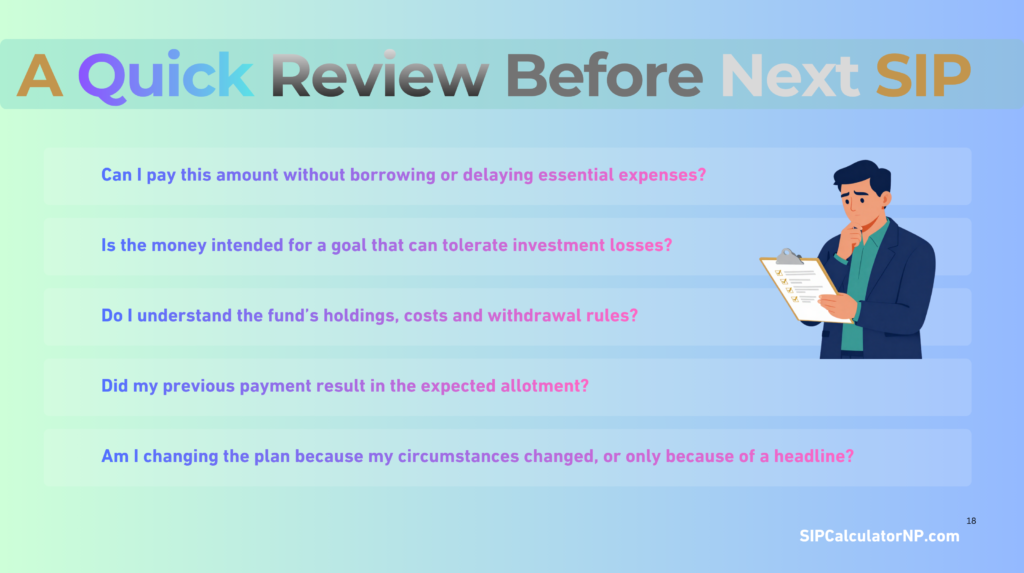
• Can I pay this amount without borrowing or delaying essential expenses?
• Is the money intended for a goal that can tolerate investment losses?
• Do I understand the fund’s holdings, costs and withdrawal rules?
• Did my previous payment result in the expected allotment?
• Am I changing the plan because my circumstances changed, or only because of a headline?
Frequently asked questions
There is no universal answer. Check your fund’s actual exposure, your cash needs and your investment horizon. A market decline does not guarantee either a quick recovery or further losses.
First restore a workable budget. A catch-up contribution is optional and should depend on available surplus and the fund’s rules. There is no basis for assuming it will always buy at a good or bad NAV.
No. It may be a manageable way to invest if it meets the scheme minimum and suits your finances. Compare charges and expectations, rather than assuming a small amount will produce a large future sum.
Research checked: 27 September 2026. This article is general education, not a personal investment recommendation. Scheme terms can change; confirm current requirements with the provider.




💬 1 Comment