
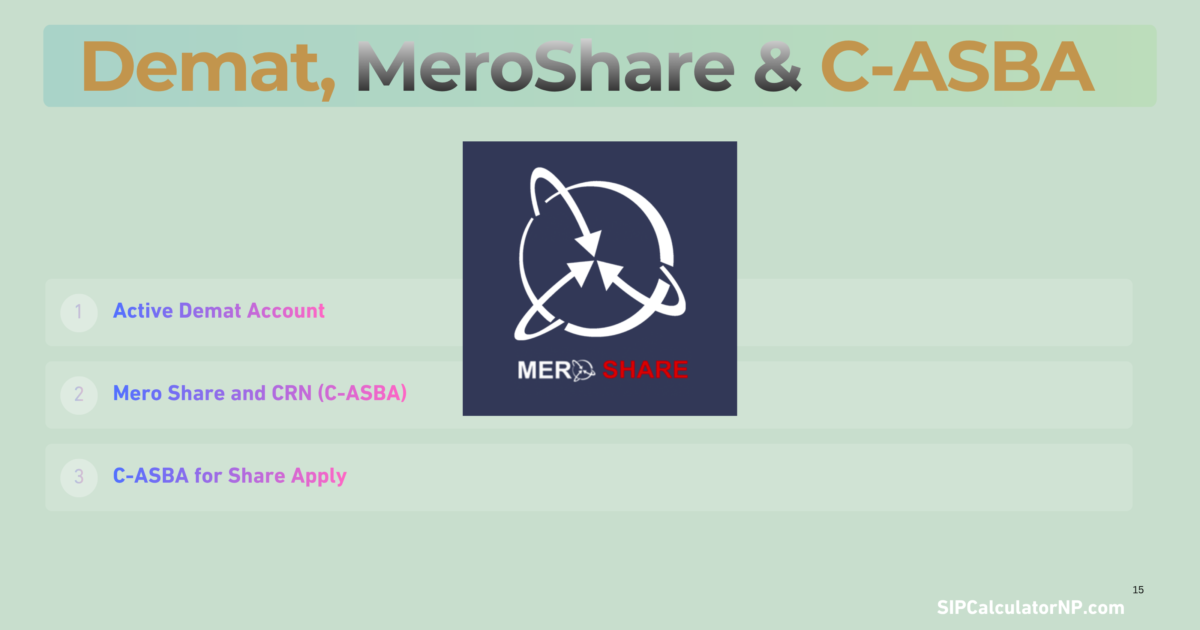
A Demat account, MeroShare access and C-ASBA registration serve different purposes. Do not assume that all three are mandatory for every SIP. Your chosen mutual fund’s registration requirements determine what you need. For example, NIMB Ace Capital explicitly requires a Demat account for NIBL Sahabhagita Fund’s SIP. Its registration and payment process runs through the fund’s own service channels. Source: NIMB Ace Capital FAQs.
If you already apply for IPOs, you may have much of the account setup in place. You still need to register for the particular fund and arrange its accepted payment method. An IPO application and a recurring SIP purchase are separate transactions.
What each account or service does
Records securities electronically through a Depository Participant, or DP.
Your investor details and 16-digit Beneficial Owner Identification Number, or BOID.
CDSC’s online service for viewing securities information and accessing services such as My ASBA.
Whether access is active, and whether your scheme requires it for a particular task.
C-ASBA supports public-issue applications using blocked bank funds; CRN is the registration number obtained through your bank.
Whether your intended transaction uses C-ASBA. A CRN is not a universal SIP payment mandate.
Manages the chosen scheme’s registration, transactions and statements.
The official website, your registration status and supported payment options.
CDSC’s MeroShare manual explains CRN use for My ASBA public-issue applications. It is an older interface guide, so use it to understand the process and check current screens with your DP or bank.
Do you need MeroShare and C-ASBA for a SIP?
Ask the fund manager two separate questions: “What do I need to register?” and “How will each instalment be paid?” These questions prevent a common mix-up between holding units, viewing units and paying for units.
MeroShare access can help you check credited holdings. It does not, by itself, create a SIP instruction. Likewise, obtaining a CRN does not automatically arrange monthly fund purchases. The correct requirements are the ones in your scheme’s current application form and payment instructions.
If you also want to apply for eligible public issues through My ASBA, arrange the necessary C-ASBA registration with your bank. For a SIP, first confirm the fund’s actual payment route instead of opening extra services on the assumption that they must be used.
A practical setup checklist
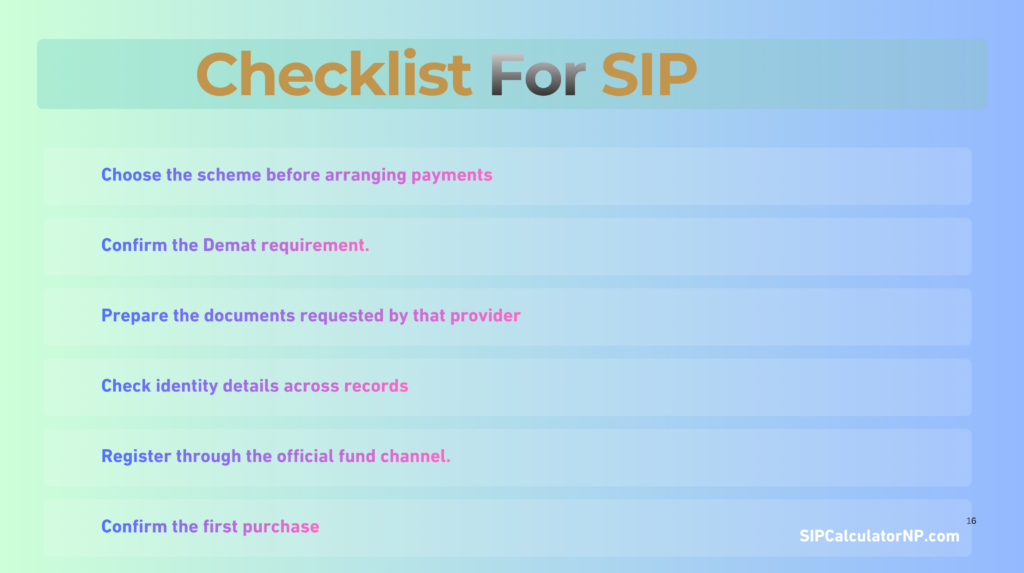
1. Choose the scheme before arranging payments. Read its objective, risk disclosures, minimum contribution, charges and redemption terms. A familiar bank name does not tell you all the fund’s conditions.
2. Confirm the Demat requirement. If you need a new account, choose a DP from CDSC’s official directory. If you have one already, check its status with your DP.
3. Prepare the documents requested by that provider. Have your identification, bank details, contact information and BOID ready. Ask about photographs, PAN, address verification and any guardian or eligibility documents applicable to you. There is no single checklist suitable for every applicant.
4. Check identity details across records. Compare your name, date of birth and BOID. Resolve mismatches through the institution that maintains the incorrect record.
5. Register through the official fund channel. Reach the portal from the manager’s verified website, rather than a social-media advertisement or forwarded payment link.
6. Confirm the first purchase. Keep the payment receipt and compare it with the fund’s transaction statement. Verify the amount, applicable NAV, charges and allotted units.
Which fees should you ask about?
Request a written breakdown of account opening and renewal costs, transaction charges and redemption costs. Ask which institution collects each charge and whether it is paid separately or deducted from your investment. Do not assume that every scheme deducts the same DP fee from every instalment.
For a small contribution, even a fixed charge can matter. A hypothetical Rs 10 fee is 1% of Rs 1,000 but 0.2% of Rs 5,000. These are arithmetic examples, not quoted Nepal fee rates. Compare the actual schedule before deciding on an amount.
Payment completed, but units are missing: what next?
Payment reference, beneficiary, amount and registration details.
Fund manager and payment provider.
Order status, applicable processing schedule and incomplete KYC requests.
Fund manager.
BOID, credit status and any stated processing period.
Fund manager and DP.
Selected DP, account access and renewal status.
Your DP.
A delay is a reason to reconcile records, not proof that everything is fine or that fraud has occurred. If the provider’s stated timeline has passed, send a written query. Avoid paying a second time until the first transaction is traced.
Frequently asked questions
No. A BOID identifies your Demat account. A CRN relates to C-ASBA registration through your bank. Enter each only in its labelled field.
Do not open another account automatically. Give the proposed manager your existing account details through its secure application process and ask whether that account meets its requirements.
Do not assume third-party payments or mismatched ownership are accepted. Follow the manager’s KYC and payment rules, including any special arrangements for minors or guardians.
No. MeroShare access and your fund’s recurring purchase arrangement are separate. Check each service independently.
Next: Learn how your payment becomes fund units, or use the salary-based SIP worksheet to choose an affordable amount.
Research checked: 27 September 2026. This article is general education, not a personal investment recommendation. Scheme terms can change; confirm current requirements with the provider.



💬 4 Comments