
SIP stands for Systematic Investment Plan. In mutual funds, it means investing a chosen amount at regular intervals into a selected scheme. In Nepali, it is commonly described as व्यवस्थित लगानी योजना.
A SIP is the contribution method; the mutual fund is the investment you choose. Nabil Invest’s FAQs use the same expansion: https://mutualfund.nabilinvest.com.np/faqs . Check the selected scheme’s offer document for its risks and costs.
What do the three words mean?
• Systematic: You follow a recurring schedule, such as a monthly contribution.
• Investment: The payment buys units in the selected fund, subject to its charges and transaction rules.
• Plan: You arrange an amount and schedule that fit your finances and the scheme’s available options.
For example, you might arrange to invest Rs 2,000 monthly. That describes your SIP amount and frequency. It does not identify the fund, guarantee a return or tell you when withdrawals will be processed.
SIP meaning in Nepali
व्यवस्थित लगानी योजना (SIP) भनेको निश्चित समयको अन्तरालमा छानिएको म्युचुअल फन्डमा रकम लगानी गर्ने तरिका हो। यसबाट फन्डका इकाई खरिद गरिन्छ। इकाईको मूल्य घट्न वा बढ्न सक्छ, त्यसैले प्रतिफल निश्चित हुँदैन।
A SIP can organise regular contributions, but its final value depends on the units purchased and the fund’s future NAV. The schedule itself does not set a return.
What does “SIP in a bank” mean?
People sometimes use a bank brand to describe a mutual fund offered by its associated capital company. Ask for the exact scheme name and fund manager, then read that scheme’s current document. A brand name alone does not tell you the charges, risk or purchase rules.
Read the actual application or offer document. If the product buys mutual fund units, do not treat it as a fixed deposit simply because a bank branch introduced it. Other products can also use recurring-payment language, so confirm what you are buying.
How does a SIP payment buy units?
Consider a simplified, charge-free example. Rs 2,000 at a NAV of Rs 10 buys 200 units. Another Rs 2,000 at a NAV of Rs 12.50 buys 160 units. You would hold 360 units after investing Rs 4,000.
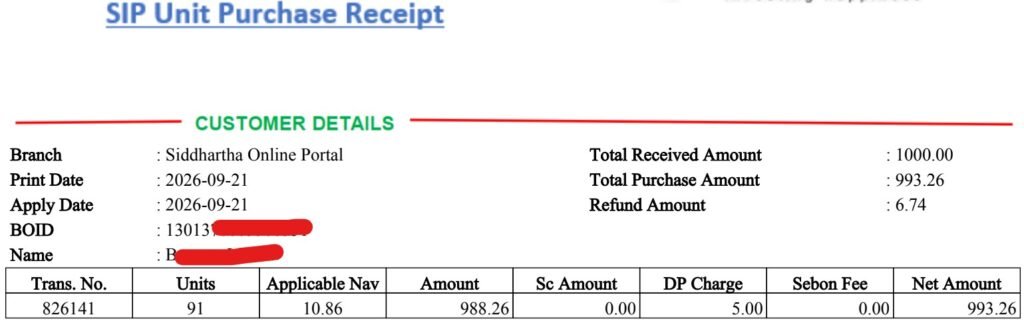
If the NAV then stood at Rs 11, those units would be worth Rs 3,960 before any applicable sale deductions. This example shows why regular payments do not guarantee a profit. Actual allotment uses the scheme’s applicable NAV, charges and rounding rules.
Read the worked NAV and unit-allotment guide for a statement reconciliation example.
SIP, mutual fund, FD and IPO: the difference
A recurring investment method.
Describes how you invest.
A pooled investment managed according to a scheme’s objective.
Describes the investment holding your money.
A bank deposit for an agreed term under the bank’s conditions.
Uses deposit terms rather than mutual fund unit pricing.
A first public offering of securities.
An application to a public issue is different from scheduling recurring fund purchases.
Terms you may see while starting
The fund’s net assets per unit; relevant to unit pricing.
The identification number of your Demat account.
The institution through which you maintain a Demat account.
The identity-verification process used by financial institutions.
A redemption charge when applicable under the scheme’s terms.
A payment instruction; its availability and operation depend on the provider.
A plan to increase contributions over time, where the provider supports the arrangement.
Frequently asked questions
A market-linked mutual fund SIP does not provide an FD-style fixed interest rate. Its value depends on the selected fund’s results and applicable costs.
No. For example, SIP can mean Session Initiation Protocol in telecommunications. This page covers the investment meaning.
No. First check affordability, emergency needs, the goal’s deadline and your ability to accept losses. Choosing a monthly schedule cannot make an unsuitable fund suitable.
Read the broader SIP in Nepal guide, work through a monthly investment budget, and check the chosen scheme’s official documents before applying.
Research checked: 27 September 2026. This article is general education, not a personal investment recommendation. Scheme terms can change; confirm current requirements with the provider.


💬 1 Comment