

When you finally start putting away a portion of your salary every month, checking your portfolio can quickly become an obsession. You want to know if your financial plan is actually working and if your sacrifices are paying off. How to calculate SIP returns is the most natural next step for any serious investor. Whether you are an employee setting aside a split of your monthly salary or a university student trying to cover the future costs of a higher degree, you need to know what that cash will look like in five, ten, or fifteen years. Let’s break down the math so you can track your money with absolute confidence.
Why It’s Not Like a Regular Bank Deposit
If you have ever opened a standard Fixed Deposit (FD), the math is incredibly easy. If you lock away Rs. 56,000 at a flat 5% interest rate, you can calculate your exact profit on the back of a napkin or waste paper at the bank. Compared to a fixed deposit, learning the steps on SIP returns calculation, including how you calculate them, involves more steps.
But Mutual funds don’t work like that. The stock market moves every single day. Because you are investing a fixed amount every month at different market prices (different NAVs), your returns are compounding at different rates. That makes figuring out exactly how SIP is calculated more complex than just multiplying a flat percentage against your total balance.
The Real-Life Math: A Practical Example
To really understand the growth, we have to look at the power of compounding. Let’s imagine you decide to build a solid financial habit. You set up a standing instruction at your bank to automatically deduct Rs. 4,000 every single month. To make sure you never accidentally spend it, you schedule this deduction for the 21st Gatey of every Nepali calendar month, right after your paycheck clears. This way, your practical steps for how to calculate SIP returns can be checked and compared with real investment outcomes.
(Note: As SIPs are the product of Capital and Investment Banking their Parent Companies Like Banks doesn’t offer a direct monthly money deduction).
You keep this up for 10 years.
- Total money you invested: Rs. 4,80,000 (Rs. 4,000 x 120 months)
Now, let’s assume your chosen equity mutual fund delivers an average annual return of 12%. Because your returns are reinvested and start earning their own returns, your money doesn’t just grow in a straight line; it curves upward. After 10 years, that Rs. 4.8 lakhs of your own money would grow to roughly Rs. 9.3 lakhs. Your wealth almost doubled just because you gave it time to compound. Calculating SIP returns in this way helps you see the real power of compounding your investments.
The Formula Behind the Scenes: How to Calculate SIP Returns
If you love spreadsheets and want to know the exact mathematical formula used by financial experts, it is based on the Future Value of an annuity. Here, the steps for how to calculate SIP returns are grounded in this concept.
The formula looks like this:
Future Value
\[ FV = P \times \frac{(1 + i)^{n} – 1}{i} \times (1 + i) \]
- FV
- Future Value
- P
- Monthly Investment
- i
- Periodic Interest Rate
- n
- Total Periods
Here, $FV$ is your future expected amount, $P$ is your monthly investment amount, $i$ is your expected monthly return rate (annual rate divided by 12), and $n$ is the total number of months.
However, because your investments happen at different times, the most accurate way financial institutions measure your actual historical performance is by using a metric called XIRR (Extended Internal Rate of Return). XIRR calculates the annualised yield of multiple cash flows happening at different times. This is generally the default method for SIP returns calculation. Thus, understanding how you calculate SIP returns using XIRR is crucial for investors who want realistic figures.
How to Calculate SIP Returns: The Easiest Way using our Digital Calculator
Let’s be completely honest. Nobody is sitting at their desk manually crunching the XIRR formula every time they want to check their portfolio. For these calculations, the best way is by using the SIP Calculator, which we offered for you. Using our SIP Calculator online page, you will be the one to get a clear roadmap, returns and well details of your investment decision. So, let’s get into the practical steps for SIP Return Calculation. By using our SIP return calculator, you can see in seconds exactly how to calculate your SIP returns and projected value.
Simple Steps to Calculate SIP Returns
- Visit our SIP Calculatore Home Page, and see how simple it is to calculate SIP returns by following the instructions below.
- Now by default you are in SIP Mode Section, if not, then tap on SIP from the other menu (Lumpsum, Step UP, & Goal Planner),
- Enter the Desired Amount that you want to invest monthly, under Monthly Investment (NPR),
- Now enter the no. of years you want to invest under, Investment Period option,
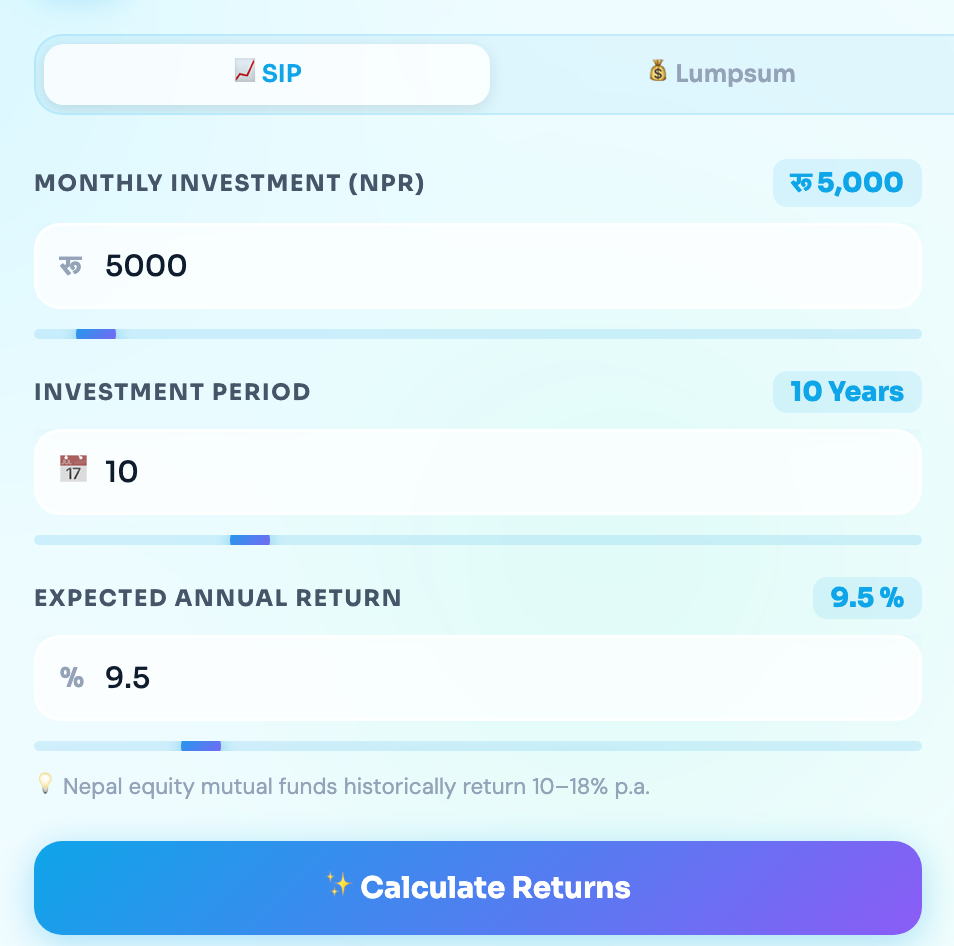
- Enter the Expected Rate of Return as (Dividend %) that you may get in an average under the Expected Annual Return option,
- That’s all, here you will get all Calculation result under the Maturity Value (SIP) details. After finishing these steps, you’ve actually walked through the practical process of how to calculate your SIP returns yourself.
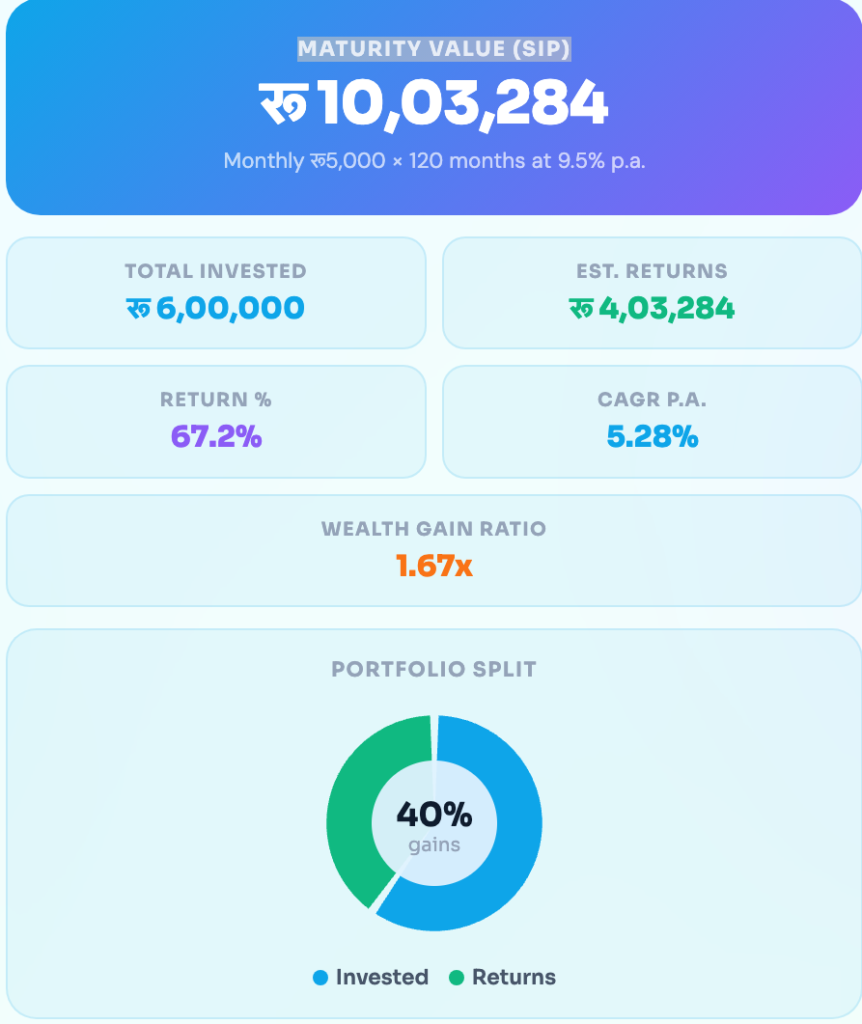
Here you can also see the Monthly and Yearly Breakdown to get more clear idea of your each monthly investments. In just a few steps, you now know how to calculate returns from your SIP with this tool.
Wrapping It Up
At the end, learning how to calculate SIP returns isn’t about being a genius and following the calculations. It’s just a simple and clear way of understanding the massive advantage of regular investing and compounding in it. Once you see the numbers and realise how much a simple monthly habit can grow over a decade, it becomes a lot easier to stay disciplined and keep investing. Automate your payments, check your calculator to stay motivated, and let your money work for you.




💬 1 Comment