Most Nepali investors learn SIP first — money going in every month. SWP is the opposite direction: a Systematic Withdrawal Plan, where you take money out on a schedule from an investment corpus. In this article, we’ll explore how swp in nepal works and what investors need to consider.
People search SWP in Nepal, SWP calculator Nepal, and SIP vs SWP when they are planning retirement cash flow, or when they want regular withdrawals without redeeming everything at once.
SWP In Nepal
This guide explains what SWP is, how it differs from SIP and dividends, and how to use the SWP calculator (/swp-calculator/) without treating the output as a promise.
What is SWP?
*SWP (Systematic Withdrawal Plan)* means redeeming a fixed amount (or fixed units, depending on the product rules) from a mutual fund holding at set intervals — monthly is the common mental model.
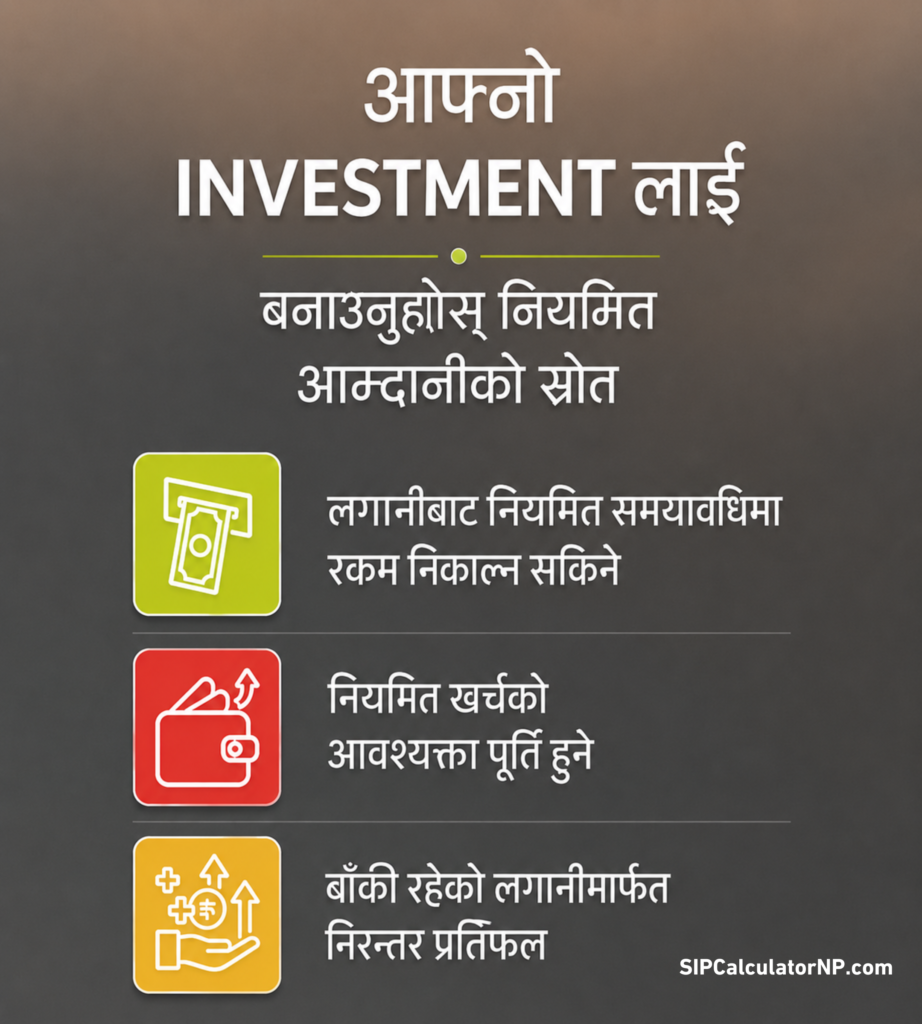
In Nepal, some issue manager like Laxmi Sunrise Capital offers the SWP features in their SIP Investment. But in Nepal’s open-ended fund world, availability and exact mechanics of SWP depend on the *fund manager’s* redemption / SWP features. So, you always have to check whether your SIP scheme supports a formal SWP mandate or only manual partial redemptions.
SWP vs dividend vs full redemption
- Cash dividend — the issuer manager distributes when they declare; not a salary you set.
- SWP / staged redeem — you choose a withdrawal pattern (where the product allows).
- Full redemption — exit the holding; it’s the process of ending the relationship in SIP with that issue manager by withdrawing an amount equivalent to NAV.
See How to Close SIP online in Major Issue Managers.
Do not assume SWP “guarantees” lifelong income. NAV moves; corpus can fall if withdrawals exceed growth.
When Nepali investors look at SWP
- Near retirement, after years of SIP
- Replacing a chunk of “interest from FD” thinking with market-linked drawdown (different risk)
- Funding a known expense for a few years without selling 100% on one day
If you are still in accumulation, SIP + step-up usually matters more: step-up SIP calculator.
How to estimate with the SWP calculator
- Use the site tool: SWP calculator Nepal,
- Practical approach:
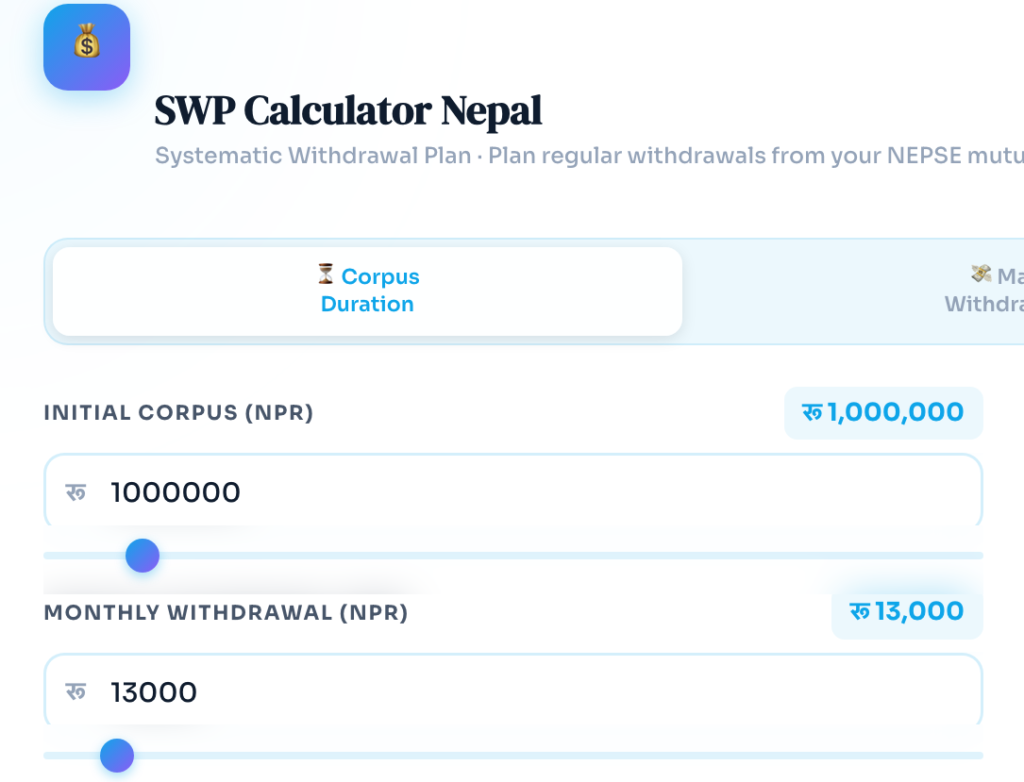
- Enter your Initial Corpus, and set the Monthly withdrawal,
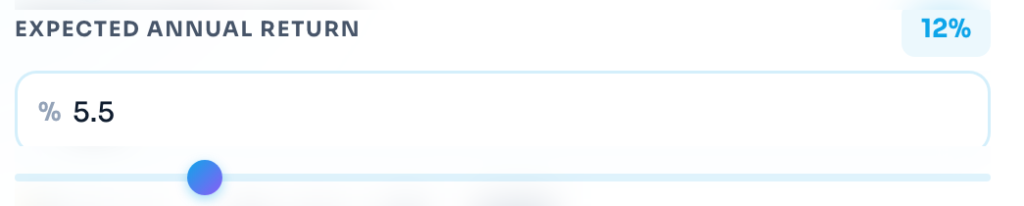
- Now set the expected annual return on your SIP,
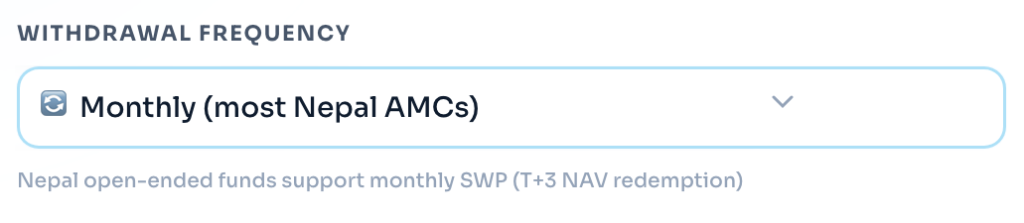
- Set the Withdrawal Frequency. Here I am setting it as a monthly income source; I chose monthly,
- Now tap on Calculate SWP; that’s all.

The SWP Calculator only produces the estimated results based on your input. So, make sure that markets, fees, taxes, and scheme rules change outcomes.
SWP and Nepal mutual fund process notes
- Redemptions settle under manager rules and banking timelines — for your scheme.
- Exit load on early withdrawal, or redemption, may apply inside certain holding periods, so read the terms set by that issue manager for SWP in Nepal.
- Tax treatment can matter on gains — do **not** rely on blog guesses; confirm with a licensed advisor / current law.
- Stopping SIP and starting withdrawals are separate decisions; you can pause contributions without automatically enabling SWP.
SIP then SWP — a simple lifecycle picture
Moving from a Systematic Investment Plan (SIP) to a Systematic Withdrawal Plan (SWP) marks a major shift in your financial lifecycle: you are transitioning from wealth accumulation (growing your corpus) to income generation (drawing a steady cash flow).
Treating your retirement or income phase the same way you treated your accumulation phase is a common pitfall. Here are the key points to consider for a seamless and sustainable transition:
Pause Early: Stop your SIPs 3–5 years before needing the income to avoid forced selling during a market crash.
Shift Risk: Move the money you will need soon from aggressive, high-risk equity funds into stable debt or hybrid funds.
Use Buckets: Divide your money into three buckets: a safe one for immediate SWP withdrawals, a moderate one for the medium term, and an equity one for long-term growth.
Withdraw Sustainably: Keep your annual withdrawal rate conservative (usually 4–6% of your total corpus) so you do not run out of money.
Enjoy Tax Benefits: You are only taxed on the capital gains of each withdrawal, not the principal, usually qualifying for lower Long-Term Capital Gains (LTCG) rates.
FAQ
No. As of now, SWP is only offered by a few issue managers, so confirm with your issue manager whether formal SWP exists or only manual redemption.
No. Both are market-related products and sit on market-linked units. Here, SWP adds sequence-of-returns-of-risk if you withdraw during a fall.
FD is a bank product that promises to pay a fixed interest on your deposit. SWP is a market-related product, and it’s not a substitute for guaranteed return. So, compare carefully with the FD calculator.
Next step
Open the SWP calculator, run two return assumptions, and write down the withdrawal and compare the plan that still works in the conservative case. Then confirm with your fund manager whether SWP or partial redemption is the real tool for your scheme.
Conclusion
SWP in Nepal is still in a basic phase compared to SIP. Although SIP is becoming habitual for Nepali investors, this SWP is not practiced fully. Only a few issue managers, like Lami Sunrise Capital, with Subha Laxmi Kosh SIP, are introducing this SWP Plan in Nepal. Here I’ve covered everything about SIP and SWP in Nepal.
Mutual fund investments are subject to market risk. Educational content only — not personalised financial advice.